Is your brand visible in AI search?
Discover asks ChatGPT, Gemini, Perplexity, Claude and Google AI Overviews the questions your buyers ask, three times each on paid plans. You get one AI Readiness Score, your rank against competitors, and your results on every engine.
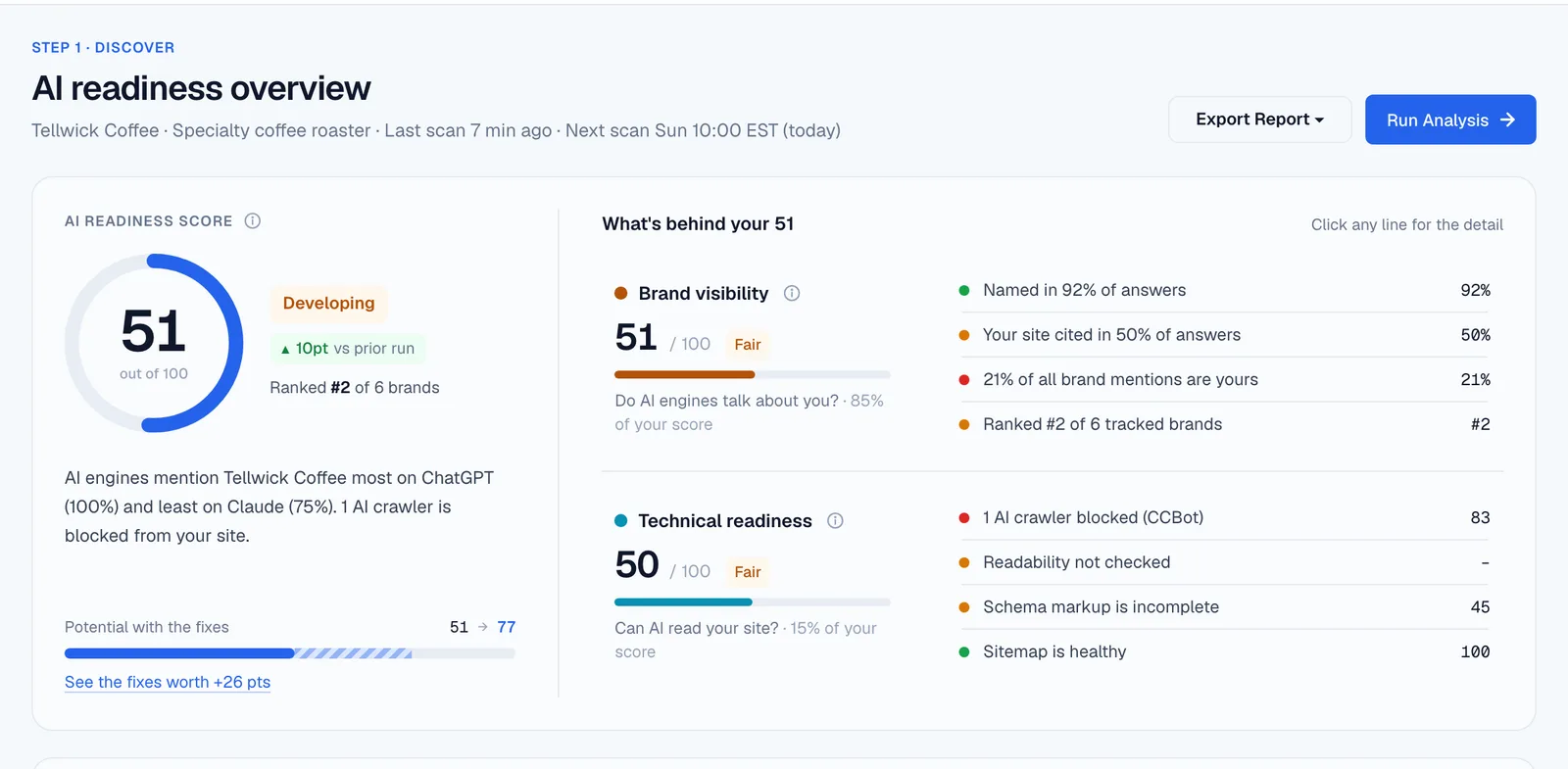
Am I visible?
When a buyer asks AI for a recommendation in your category, does it name you? How often, how prominently, and does it link to your site? Discover answers that for every engine and every buyer question, side by side with your competitors.
01 · Am I visible?
Discover
Your score, your rank and your results on every engine.
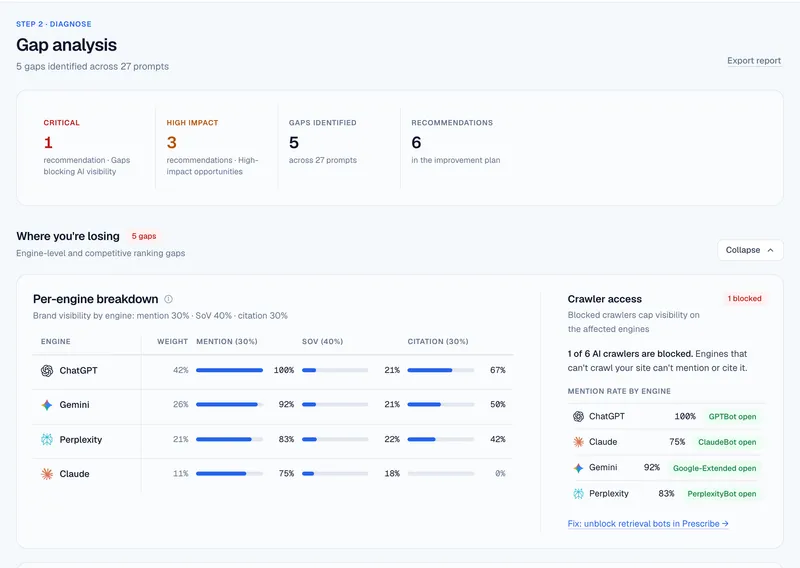
02 · What's wrong?
Diagnose
Where you lose, to whom, and why.
Diagnose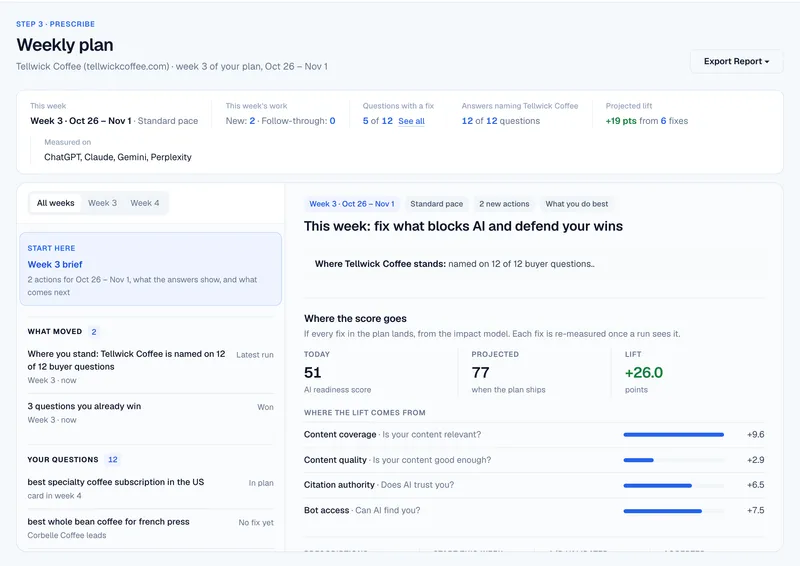
03 · How do I fix it?
Prescribe
A ranked plan with projected lift and hours.
Prescribe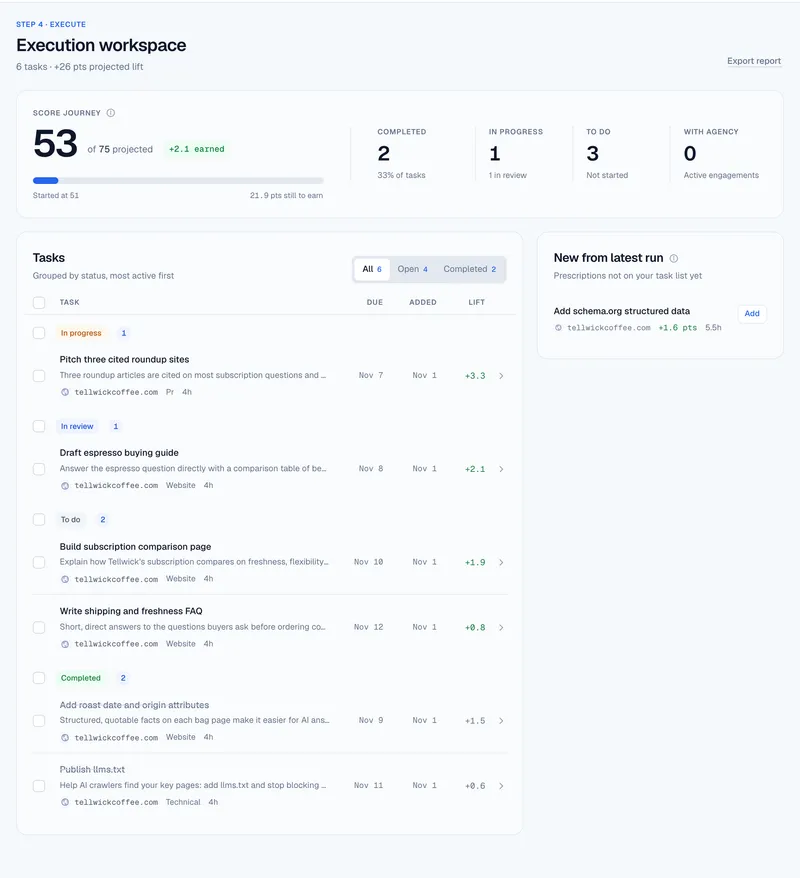
04 · Get it done.
Execute
Briefs, drafts and hands-on help.
Execute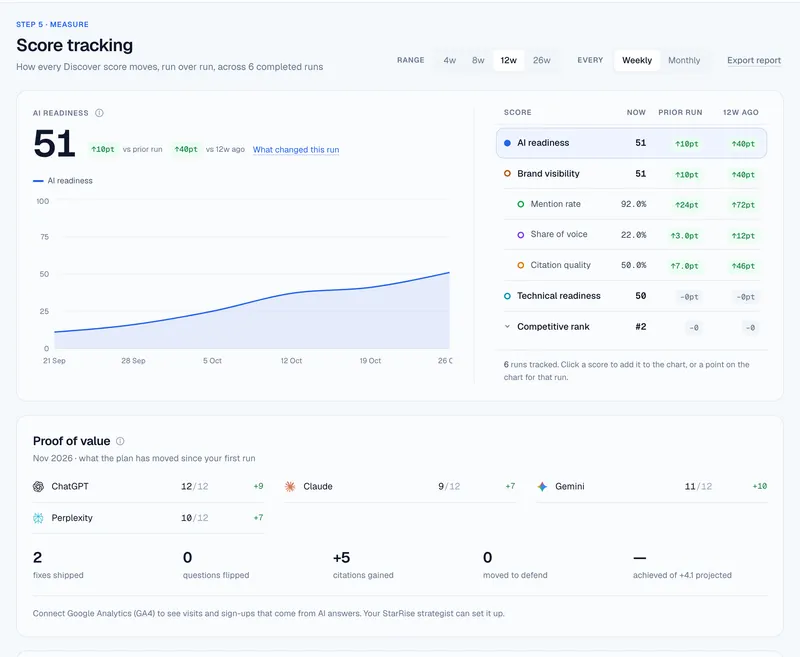
05 · Did it work?
Measure
What moved since your last run.
Measure
Four views that tell you where you stand
Discover is the first screen after every run. It is built to be read in a minute and shown to your leadership team.
- AI Readiness Score: one number, 0 to 100. Your headline score, with the change since your last run. It combines how visible your brand is in AI answers (85%) with whether AI crawlers can read your site (15%).
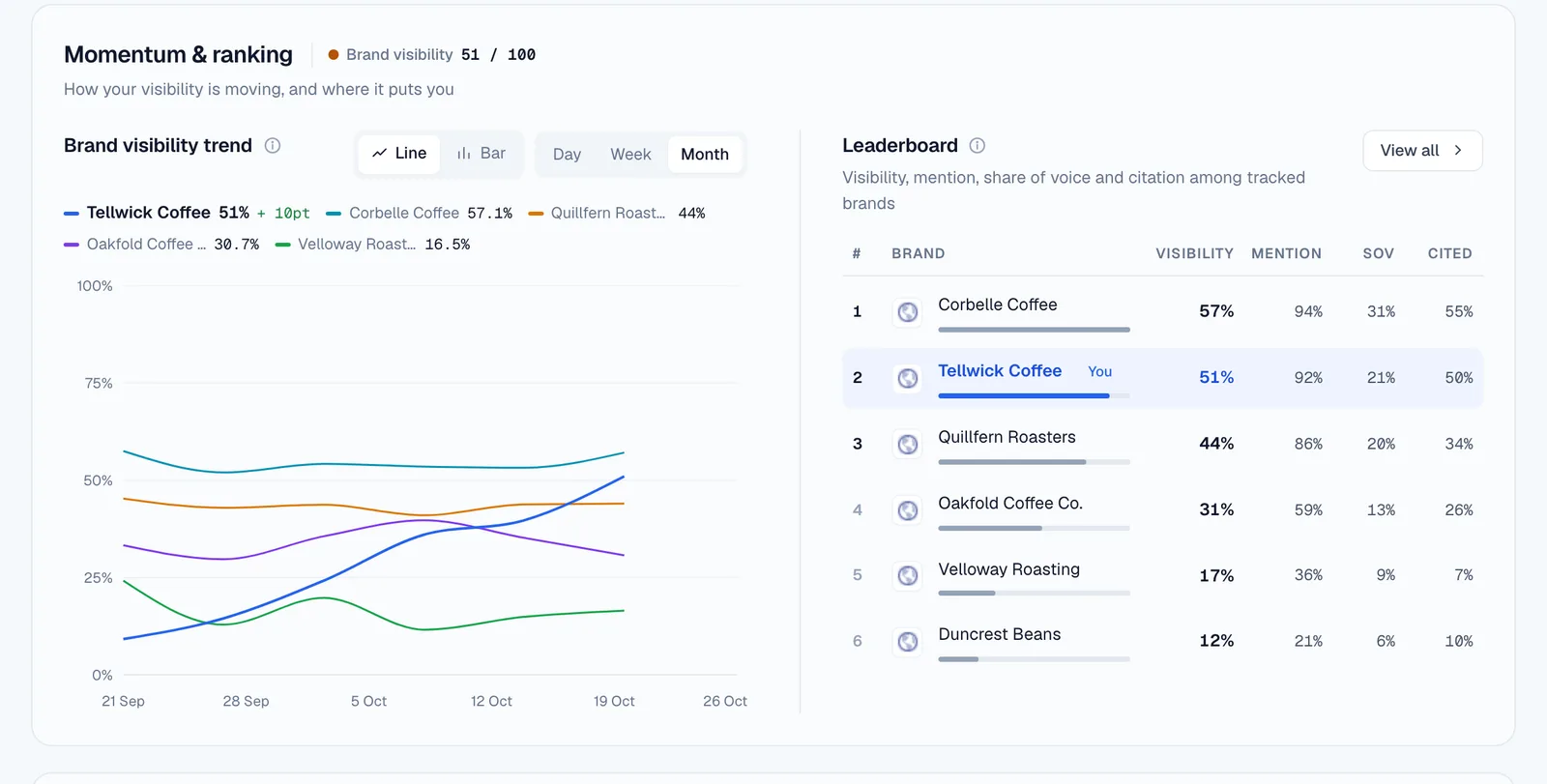
- Competitive brand visibility: your rank against every competitor. A table of every brand you track, with how often each one is named, how prominently, and how often its site is cited. You see who leads and by how much.
- AI Readiness trend: your score, run over run. Your score and your top competitors' over time, on the same questions and engines, so every point compares fairly. A badge shows the change since your last run.
Your score on each engine
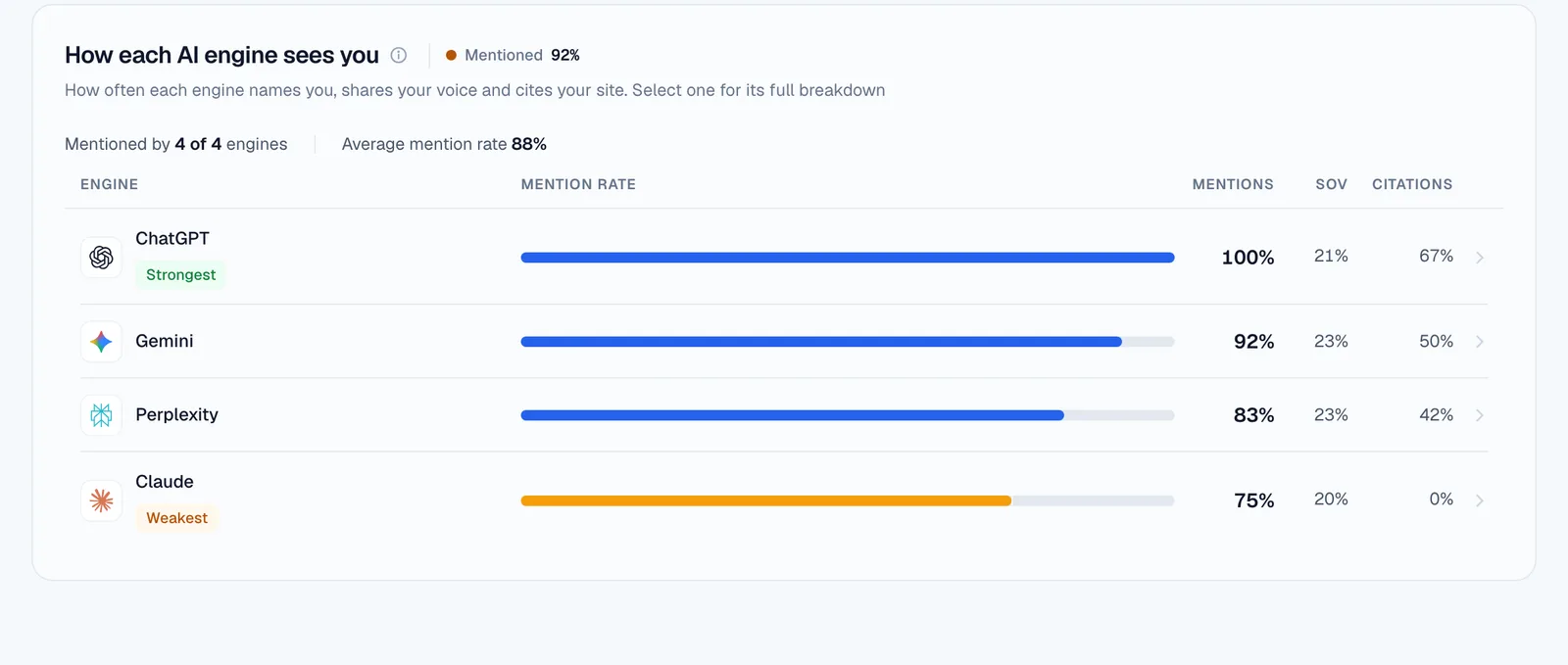
Engines disagree. One may cite you often while another barely names you. A single blended number would hide that.
Does AI talk about you, and can AI read your site?
The AI Readiness Score answers both questions in one number.
AI Readiness Score
85% Brand Visibility + 15% Technical Readiness
One number from 0 to 100 for how ready your brand is to be found and recommended in AI search.
Brand Visibility
30% mention rate + 40% share of voice + 30% citation rate
How present and how trusted your brand is in the answers to your buyers’ questions.
Technical Readiness
Crawler access, readability, structured data and sitemap
Whether AI search crawlers can reach your site and read it: robots.txt rules for AI crawlers, llms.txt, schema markup and your sitemap.
Asked three times
On paid plans, every question goes to each AI engine three times, so one odd answer can't swing your score.
Checked where buyers look
On paid plans, alongside the official APIs, we check the answers buyers see in the consumer ChatGPT app and in Google AI Overviews.
Verified citations only
A citation counts only when the engine really links to your domain. Nothing inflates the headline.
Discover is on every plan
Start free on ChatGPT. Paid plans add engines, more questions and competitors, three samples per question and a weekly analysis.
| Plan | What Discover covers |
|---|---|
| Free | ChatGPT, 4 prompts, 1 competitor, one run a month. AI Readiness Score, competitor ranking, how ChatGPT describes you. |
| Starter | ChatGPT, Gemini, Perplexity and Google AI Overviews. 20 prompts, 5 competitors, weekly analysis. |
| Pro | Claude available as an add-on. From 30 prompts and 10 competitors. |
| White Glove | From 50 prompts and 20 competitors, Claude included. |
Questions about Discover
How do you choose the questions you ask the AI engines?
From your website and real search demand. StarRise works out what you sell, then writes the questions buyers ask across the journey, from "do I need this" to "who should I hire". Each comes with its monthly search volume. You review them, remove any, and add your own.
How do you pick my competitors?
StarRise finds the brands that offer what you offer in your market. You confirm the list, drop any that don't fit, and add the ones you meet in deals.
Why ask each question three times?
AI engines rarely give the same answer twice. On paid plans, three samples per question per engine mean a single odd answer doesn't swing your score.
Do you measure what real users see?
Yes. On paid plans, alongside the official APIs, we check the answers buyers actually see in the ChatGPT app and in Google AI Overviews. The consumer app and the API don't always agree, so we measure both.
How long does a run take?
Minutes. Your first results arrive shortly after you press run, and you can re-run any time on the same questions and engines.