GEO vs AEO vs SEO: what's the difference?
Three acronyms, one buyer. SEO gets your pages found in search results. AEO and GEO get your brand into the answers AI engines write. Here is what each one means, where they overlap, and which parts of your SEO work carry straight over.
SEO · Search engine
Rank in the results.
Earn a high position in a list of links.
AEO · Answer engine
Be the answer.
Have your content chosen as the direct answer to a question.
GEO · Generative engine
Be named and cited.
Appear in the answers ChatGPT, Gemini, Perplexity, Claude and AI Overviews write, with a link to your site.
AIO · AI optimization
Be present.
A broad label for brand presence in AI answers. Also short for Google's AI Overviews.
What each term means
People use these words loosely, and vendors stretch them. These are the working definitions we use.
SEO · Search engine optimization
Getting your pages ranked
The work of earning a high place in search results: crawlable pages, relevant content and links from trusted sites. Success is a rank and a click.
AEO · Answer engine optimization
Getting your content chosen as the answer
Shaping pages so an engine can lift a direct answer from them. It started with featured snippets and voice assistants, and now covers AI answers too. Success is being the answer the engine gives.
GEO · Generative engine optimization
Getting named and cited in AI-written answers
Making your brand the one AI engines recommend, and your pages the sources they link to. Success is a mention in the answer and a citation to your site.
AIO · AI optimization
Getting present in AI answers at all
Used by some writers for brand presence across AI answers, as distinct from citation. Watch for the clash: AIO also abbreviates Google AI Overviews.
The split that matters more than the acronym. Some writers separate two goals. One is presence: the AI names your brand in its answer. The other is citation: the AI links to your page as its source. They need different work. Presence comes from being talked about across the web. Citation comes from having the page the engine chose to quote. We track both, because a brand can have one without the other. Mentioned is being known. Cited is being trusted.
GEO vs AEO vs SEO, compared
| Topic | SEO | AEO | GEO |
|---|---|---|---|
| The goal | Rank high in search results | Be the direct answer | Be named and cited in AI-written answers |
| Where it shows | Google and Bing results pages | Featured snippets, voice answers, AI answers | ChatGPT, Gemini, Perplexity, Claude, Google AI Overviews |
| What the buyer sees | Ten blue links | One answer | A written answer naming three to five brands |
| You start from | Keywords | Questions | Prompts: the full questions buyers ask an assistant |
| Unit of success | Rank and click | Being the selected answer | Mention, share of voice, citation |
| Main signals | Links, relevance, technical health | Clear question-and-answer structure | Crawler access, clear answers, evidence on the page, trusted third-party sources |
| Does it vary? | Fairly stable day to day | Fairly stable | The same question can get a different answer each time |
| How you measure it | Rank trackers, Search Console | Snippet tracking | Ask each engine real buyer questions, repeatedly, and score the answers |
Each one builds on the one before
These aren't rival strategies. Most AI engines search the web before they answer, so a page has to be found before it can be quoted, and quoted before it can be cited.
01 · SEO
Get found
Crawlable pages in the indexes AI engines search: Google, Bing, Brave and the engines' own. If a bot can't reach a page, nothing downstream works.
02 · AEO
Get quoted
A clear answer to the buyer's question near the top of the page, structured so an engine can lift it as written.
03 · GEO
Get named and cited
Evidence on the page and a presence in the sources engines trust, so your brand is the one recommended and your page the one linked.
What transfers, and what's new
If you have an SEO team, most of their skills carry over. The scoreboard is what changes.
Transfers from SEO
- Crawlability and indexing. AI engines read search indexes. Sitemaps, clean robots rules and fast pages still matter.
- Authority. Links and mentions from trusted sites help engines find and trust you.
- Helpful content. Pages that answer the searcher's question well.
- Structured data. Schema markup helps engines read your pages cleanly.
- Site structure. One clear page per topic beats one page that tries to cover everything.
New with GEO and AEO
- The answer is the destination. The engine names three to five brands. There is no page two.
- Prompts, not keywords. Buyers ask full questions, by buyer stage, and each one needs a page that answers it.
- Evidence wins quotes. Statistics, expert quotes and cited sources make a page easier to cite than opinion does.
- Third-party sources. Review sites, Reddit threads and LinkedIn shape what engines say about you.
- New bots. Separate search and training crawlers per vendor. See the crawler guide.
- Answers vary. One check is a guess. You need repeated samples to know where you stand.
The scoreboard for GEO and AEO
StarRise is an AI Search Optimization Platform. It measures the surface your SEO tools can't see, then tells you what to fix.
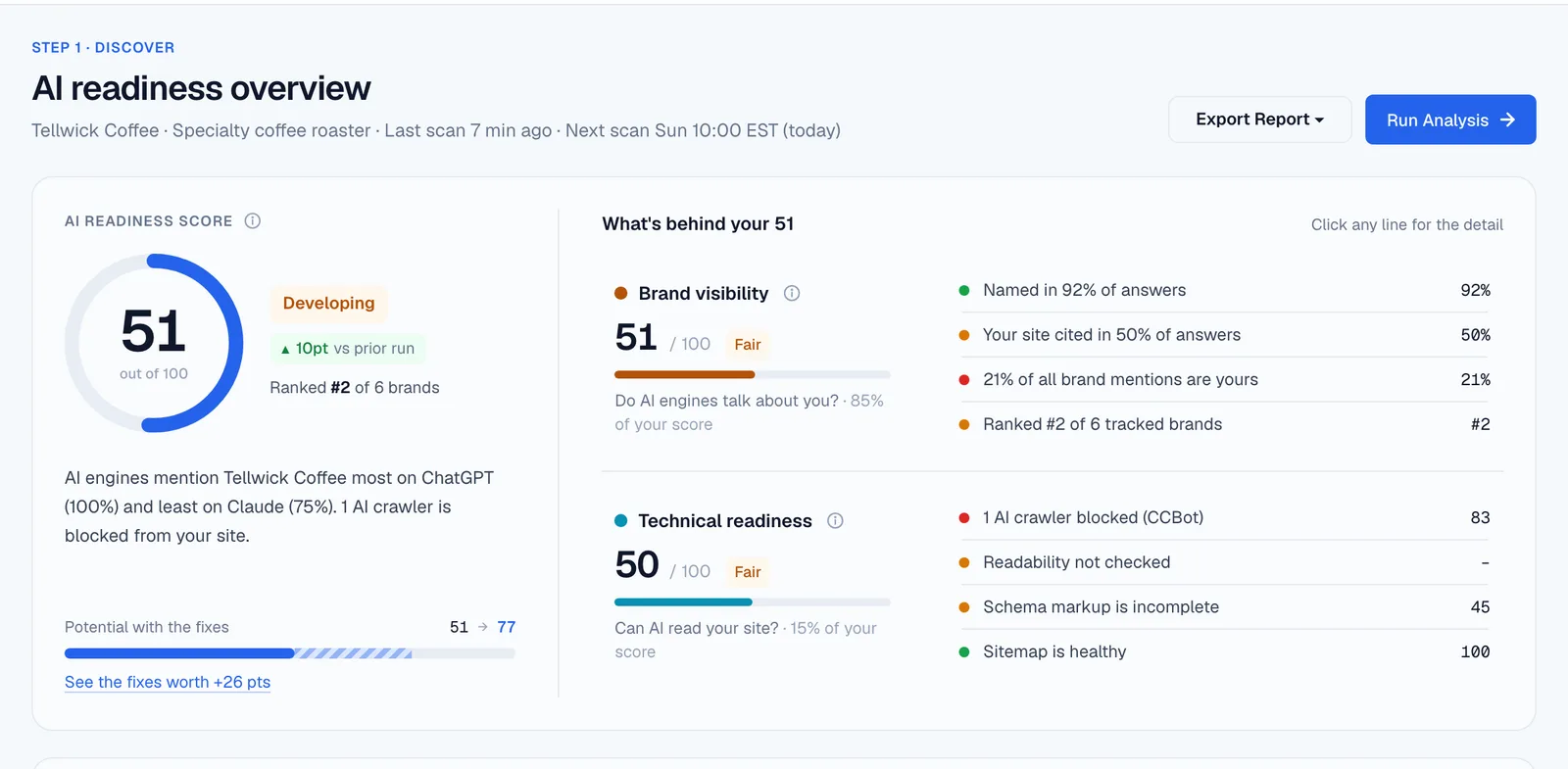
Every buyer question goes to each engine on your plan (ChatGPT, Gemini, Perplexity, Claude and Google AI Overviews), three times per engine on paid plans. The AI Readiness Score combines Brand Visibility (mention, share of voice and citations, 85%) with Technical Readiness (can AI crawlers reach and read your pages, 15%).
Keep your SEO stack. StarRise sits next to it. The SEO Snapshot add-on (on Pro) puts your search authority beside your AI score in one view.
- Discover: am I visible? Mention, share of voice and citations, engine by engine.
- Diagnose: what's wrong? Where you lose, to whom, and why the engine preferred them.
- Prescribe: how do I fix it? A ranked plan, each fix with a projected lift.
- Execute: get it done, with content drafts or our GEO team.
- Measure: did it work? A re-run on the same questions and engines, compared with the last.
GEO, AEO and SEO questions
Is SEO dead?
No. AI engines search the web before they answer, and they read search indexes to do it. Pages that can't be found can't be cited. What changed is the finish line: being in the AI's written answer, next to or instead of a blue link.
Isn't GEO just SEO with a new name?
The skills transfer. The scoreboard doesn't. Google ranks pages in a list. AI engines write an answer, name three to five businesses and cite the pages they trust. A rank tracker can't tell you whether you're in that answer, or who is instead.
Is AEO the same as GEO?
They overlap heavily, and many people use them interchangeably. AEO grew out of featured snippets and voice answers and focuses on being the answer. GEO focuses on generative engines like ChatGPT and Perplexity, and on being both named and cited. The practical work is largely the same.
What does AIO mean?
Two things, which causes confusion. Some writers use AI optimization (AIO) for brand presence across AI answers. Others mean Google AI Overviews. Check which one is meant before comparing notes.
How do you measure GEO?
Ask each engine the questions your buyers ask, more than once, and record whether you're named, how prominently, and whether your site is cited. On paid plans, StarRise asks every question three times per engine, so one odd answer can't swing your score. Engine by engine: ChatGPT, Gemini, Perplexity, Claude.
How long does GEO take to work?
Fixes on your own site show up as engines re-read it, typically within a few weeks. Wider citation authority builds over a couple of months. Nobody can honestly promise a rank or a date.