What is generative engine optimization (GEO)?
Generative engine optimization is how you get your brand named and cited when people ask AI for answers. Here is what it is, how AI engines choose their sources, and a practical checklist to start.
10 min read · Updated November 2026 · By the StarRise team
GEO in three points
- GEO is the practice of making your brand easy for AI engines like ChatGPT, Gemini, Perplexity and Claude to find, name and cite in their answers.
- AI engines search the web, read a handful of pages and quote the ones with clear answers and evidence. Research found statistics, quotations and cited sources make content more visible in AI answers.
- Measure GEO with three numbers: how often you're mentioned, your share of voice against competitors, and how often your site is cited. Ask each question more than once, because AI answers vary.
Generative engine optimization, defined
Generative engine optimization (GEO) is the practice of improving how often, how prominently and how accurately AI engines mention and cite your brand when they answer questions in your category.
A generative engine is any AI system that writes an answer instead of returning a list of links. ChatGPT, Gemini, Perplexity, Claude and Google's AI Overviews all work this way. Ask one "who are the best accounting firms for startups?" and it replies with a short paragraph that names a few firms, gives a reason for each, and often links to the pages it used.
GEO is about earning a place in that paragraph. It has two goals, and they are different:
- Being mentioned. The engine names your brand in the answer. Mentioned is being known.
- Being cited. The engine links to your website as a source. Cited is being trusted.
You'll also hear the term AEO, answer engine optimization. The two overlap heavily, and many people use them interchangeably. Our GEO vs AEO vs SEO guide covers the differences.
Why GEO matters now
Buyers increasingly ask an AI assistant for a recommendation before they search, compare or call. The answer they get is short. It names three to five businesses, and there is no second page to scroll to.
That changes the math of being found. On a search results page, ranking fifth still earns some clicks. In an AI answer, if you're not one of the names, the buyer never hears of you, and nothing in your analytics records that it happened.
Three things make GEO worth doing deliberately:
- The lists are short. A few names per answer leaves very little room, especially in local and niche categories.
- The answers change. Ask the same question twice and you may get different names. A competitor publishes a strong page, and the answer shifts.
- Your SEO tools can't see it. Rank trackers measure positions in a list of links. They don't tell you whether an AI answer named you, or who it named instead.
How AI engines pick their sources
When an AI engine answers a question about businesses or products, it usually draws on two things, then decides what to quote.
1
What the model already knows
Every language model learned from a large body of text during training. If your brand appeared often in that text, in press coverage, directories, reviews and discussions, the model may name you from memory. This knowledge changes only when the vendor releases a new model.
2
What the engine finds on the web right now
For most recommendation questions, today's engines also search the web at the moment you ask. They run one or more searches, read a handful of pages, and write an answer from what they found. This is called retrieval, and it's where GEO has the most leverage, because the pages an engine retrieves can change within weeks.
3
How the engine chooses what to quote
Once it has a set of pages, the engine favors pages that answer the question directly, back their claims with evidence, and are easy to extract a clean sentence from. A page that says "we're the leading firm" gives it nothing to quote. A page that states a specific, measured result gives it a sentence it can use.
Each engine searches a different index
- ChatGPT uses OpenAI's own search crawler and index, with third-party search data behind it. See the ChatGPT guide.
- Gemini and Google AI Overviews read Google Search's index. See the Gemini guide.
- Perplexity runs its own crawler and fetches pages live. See the Perplexity guide.
- Claude searches the web through a provider; Anthropic lists Brave Search, and Claude's citations closely track Brave's results. See the Claude guide.
Why a brand can be mentioned but never cited
If your site blocks AI search crawlers, an engine can still name you from what it already knows or from other sites. It can't link to pages it can't read. A high mention rate with a near-zero citation rate is often the first sign of a crawler problem. Our AI crawler guide explains which bots to allow.
GEO vs SEO
GEO builds on SEO. The skills transfer: technical hygiene, useful content and authority still matter. What changes is the scoreboard.
| Topic | SEO | GEO |
|---|---|---|
| Where you show up | A ranked list of links on a search results page | Inside a written answer from an AI engine |
| What success looks like | A high position and a click | Being named, named early, and cited as a source |
| How many winners | Ten links per page, plus more pages | Usually three to five names per answer |
| What the engine rewards | Relevance, links and authority signals | Clear answers, evidence, cited sources and pages that are easy to quote |
| How results vary | Fairly stable from one search to the next | Can change between two asks of the same question |
| How you measure it | Rank trackers and search console data | Asking real buyer questions to each engine, several times, and scoring the answers |
The practical takeaway: keep your SEO program. GEO adds a second surface to measure and a short list of content and technical changes that help on both.
What the research says makes content citable
The term "generative engine optimization" comes from a peer-reviewed study: Aggarwal et al., GEO: Generative Engine Optimization, KDD 2024. The researchers tested how specific changes to a page's content affected how visible that page was in AI-generated answers.
Their headline finding is useful for anyone writing for AI search: some edits made content noticeably more visible, and others did little or nothing. The methods that helped most added evidence and made the writing clearer.
- Statistics. Replace general claims with specific, sourced numbers.
- Quotations. Include quotes from named, relevant experts.
- Cited sources. Reference credible sources for your claims, and link to them.
- Clear, fluent answers. Write in plain language that answers the question directly and reads well when lifted out of context.
Keyword stuffing, the old SEO habit of repeating target phrases, did not help in their tests. The engines reward the same things a careful editor would. StarRise scores your pages on these content factors and compares them with the competitors AI names instead of you. That comparison is often where the biggest gap shows up.
A practical 7-step GEO checklist
Work through these in order. The first two are foundations; the rest compound over time.
- 1. Let AI search crawlers in. Check your robots.txt and any CDN or firewall "block AI bots" setting. Allow the search and fetch bots, such as OAI-SearchBot, ChatGPT-User, PerplexityBot, Claude-SearchBot, Googlebot and Bingbot. Blocking training-only bots like GPTBot is a separate choice and doesn't remove you from AI search. Full crawler guide.
- 2. Find the questions buyers ask AI. List the questions people ask at each buying stage, from "do I need this?" to "who should I hire?". Start from real search demand, then phrase each one the way someone would ask an assistant.
- 3. Put a clear answer at the top. Open each key page with a direct, two- or three-sentence answer to the question it targets. Define terms plainly. Make it something an engine could quote as written.
- 4. Add evidence. Replace opinions with measured results, add quotes from named experts on your team, and cite your sources. This is the step most sites skip.
- 5. Make pages easy to read for machines. Use descriptive headings, short paragraphs, lists and comparison tables where alternatives exist. Add schema markup and keep your sitemap current.
- 6. Fill the gaps in coverage. For each buyer question you have no page for, write one. Comparison and "best option for" pages matter most during the consideration stage.
- 7. Earn mentions where AI looks. Find which sources engines cite in your category: industry publications, review sites, community threads, LinkedIn. Contribute there as a genuine practitioner. Never post fake reviews or sock-puppet comments.
Then measure, fix and measure again. Changes to your own site usually show up as engines re-read it, typically within a few weeks. Wider citation authority builds over a couple of months.
How to measure GEO
You can't manage GEO by typing one question into ChatGPT and taking a screenshot. AI answers vary from one ask to the next, so a single check can flatter you or alarm you for no reason. A useful measurement has three parts.
- Mention rate. The share of answers that name your brand.
- Share of voice. How prominently you're named compared with every other brand in the answer. Being named first counts for more than being named last.
- Citation rate. The share of answers that link to your website as a source. Count only real, verified links, not URLs the model mentions in passing.
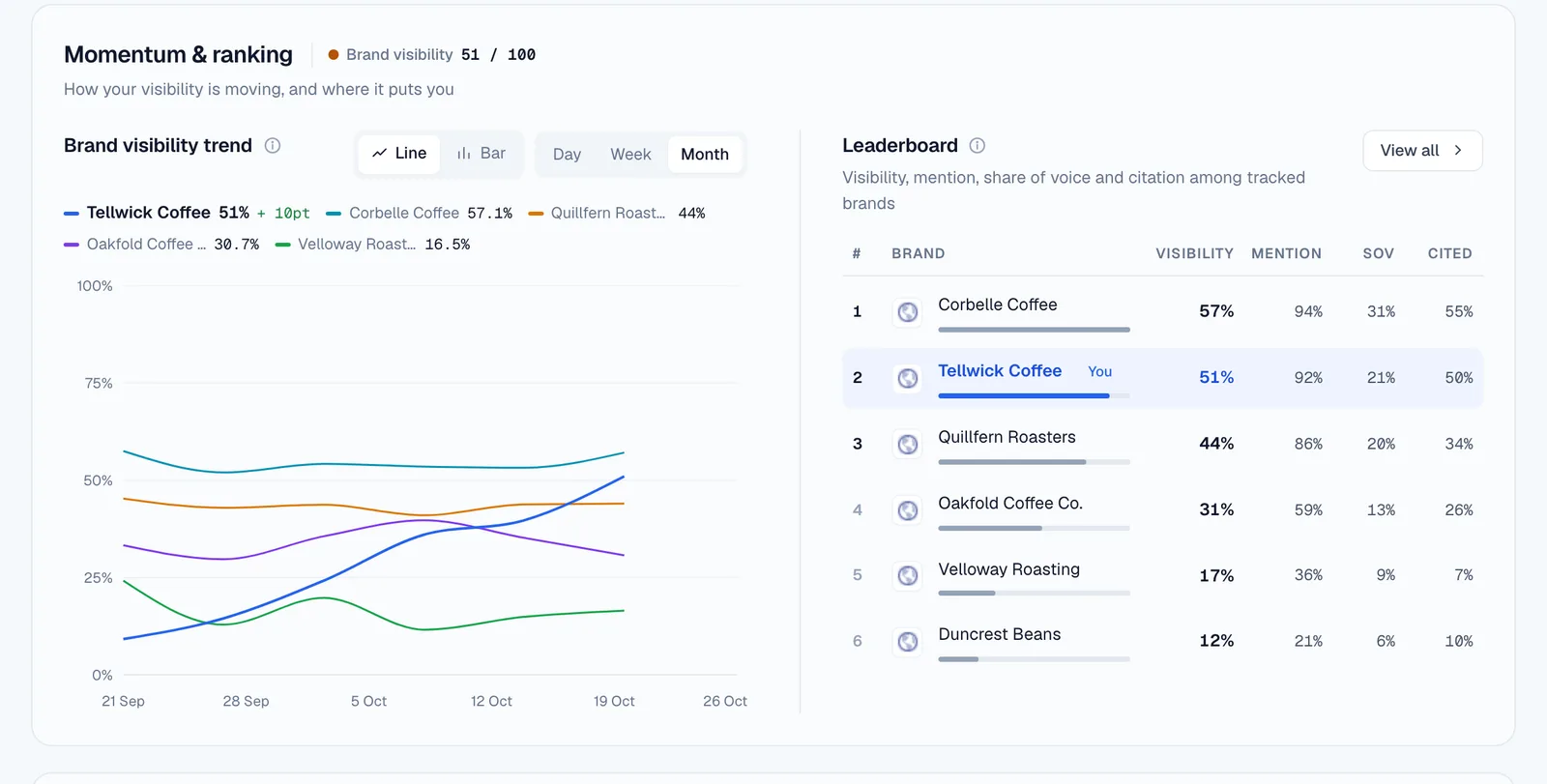
Sample more than once. Ask each question several times per engine and report the result as a rate across all your questions, not a single answer. On paid plans StarRise asks every question three times on every engine, so one lucky answer can't move your score. Compare runs on the same questions and engines, so a change in your list doesn't pass for a change in visibility.
Check technical readiness too. Visibility depends on access. Track whether AI crawlers can reach your pages, whether the pages are readable, and whether schema and sitemaps are in place. In StarRise these two halves combine into the AI Readiness Score: Brand Visibility counts for 85% and Technical Readiness for 15%.
Frequently asked questions
Is GEO the same as AEO?
They overlap almost completely. AEO, answer engine optimization, is the older term and was used for featured snippets and voice assistants. GEO was named for AI engines that write full answers. Both aim to make your brand the answer. See GEO vs AEO vs SEO.
Does GEO replace SEO?
No. Google Search still matters, and Gemini and AI Overviews read Google's own index. Good SEO makes GEO easier. GEO adds a new surface to measure and a set of content changes, like evidence and clear answers, that help on both.
How long does GEO take to work?
Fixes on your own site show up as AI engines re-read it, typically within a few weeks. Being cited more widely across other sites builds over a couple of months. Anyone who promises a rank or a date is guessing.
Do I need an llms.txt file?
It's optional. An llms.txt file is a short summary of your site for AI agents. It's cheap to add, but it doesn't grant or block access. Crawler access in robots.txt and your CDN settings matters far more.
Keep going
Guide
GEO vs AEO vs SEO
Three terms, one goal. What each one means and where they overlap.
ReadGuide
The AI crawler guide
Which bots let AI engines read and cite your site, and which only collect training data.
ReadReference
Methodology
How the AI Readiness Score is built, how we sample and what we leave out.
Read