How StarRise measures AI visibility
AI answers change from one ask to the next, so a single check is a guess. This page explains what our score measures, how we sample, what counts and what doesn't. In plain words, with nothing hidden that changes your result.
3× per engine
Every question, three times
On paid plans. One lucky answer can't move your score.
Comparable
The same questions every run
Each run compares fairly with the last.
Verified
Only verified citations
A real link to your domain, or it doesn't count.
On the record
Every raw answer
Read what each engine said in Prompt Explorer.
What the AI Readiness Score measures
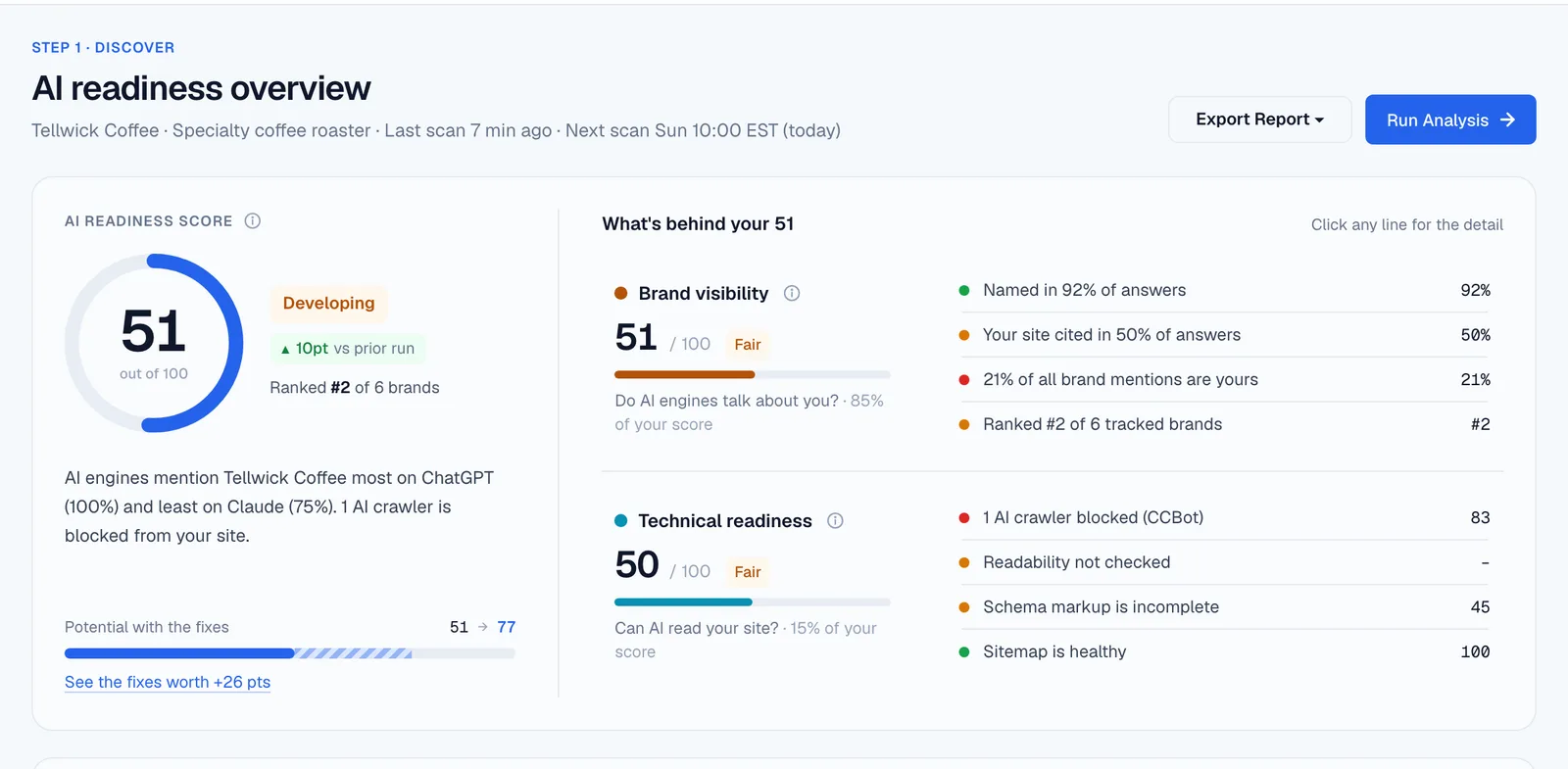
One number from 0 to 100 that answers two questions: does AI talk about you, and can AI read your site?
- Brand Visibility, 85%. Built from real answers to your buyer questions. A mention means the engine names you. Share of voice rewards being named early and described in depth over a passing mention at the end of a list. A citation means the engine links to your site as a source. Mentioned is being known. Cited is being trusted.
- Technical Readiness, 15%. Can AI crawlers reach and read your pages? We check which AI crawlers your site allows, how cleanly your pages can be read, your schema markup and your sitemap. A blocked crawler can hide a whole site from an engine. Read the AI crawler guide.
AI Readiness Score
85% Brand Visibility + 15% Technical Readiness
One number from 0 to 100 for how ready your brand is to be found and recommended in AI search.
Brand Visibility
30% mention rate + 40% share of voice + 30% citation rate
How present and how trusted your brand is in the answers to your buyers’ questions.
Technical Readiness
Crawler access, readability, structured data and sitemap
Whether AI search crawlers can reach your site and read it: robots.txt rules for AI crawlers, llms.txt, schema markup and your sitemap.
The measures that explain why you win or lose
The score tells you where you stand. These tell you what to fix.
Direct Perception
How each engine describes you in its own words: strengths, weaknesses and the terms it attaches to your name.
Sentiment & Threat
How positively AI talks about you, and which competitors threaten your position most.
Content Quality
Your pages scored on the content factors AI engines reward: statistics, quotations, cited sources and clear answers.
Content Coverage
Which buyer questions you have pages for, by buyer stage. The prompt gap map shows the ones you hand to competitors.
Citation Authority
The sources AI trusts in your category, and the pages where competitors are cited instead of you.
Social signals
How your social channels compare with competitors', because AI engines cite social posts too.
Three samples, in plain words
Ask an AI the same question twice and you can get two different answers. So on paid plans we ask each buyer question three times on each engine (on ChatGPT, Gemini and Perplexity, twice through the official API and once in the consumer app), and report a rate across all your questions.
- A rate, not a snapshot. "Named in 2 of 3 answers" on each question adds up to a rate across your whole list, so one odd answer can't swing your score.
- Same questions, same engines. Each run re-asks your tracked questions on the same engines, so the change since your last run compares like with like.
- Free is a first look. The free plan asks each question once on ChatGPT. Paid plans add the extra samples and engines.
Verified citations and the real consumer app
Verified
Only verified citations count
A citation counts only when the engine actually links to your domain as a source. A web address the model types into its prose, or a list of sources it gives when asked afterwards, is kept apart and never counts toward your score.
Consumer app
Checked where buyers ask
On paid plans, StarRise checks the answers buyers actually see in the consumer ChatGPT, Gemini and Perplexity apps alongside the official APIs, and captures Google AI Overviews as they appear in search. The app and the API don't always answer the same way, so we measure both.
Engines covered
On paid plans, every engine is asked the same questions three times each run. Google AI Overviews is one capture of the results page per keyword each run. The free plan asks once.
| Engine | Free | Starter | Pro | White Glove |
|---|---|---|---|---|
| ChatGPT | Yes | Yes | Yes | Yes |
| Gemini | No | Yes | Yes | Yes |
| Perplexity | No | Yes | Yes | Yes |
| Google AI Overviews | No | Yes | Yes | Yes |
| Claude | No | No | Add-on | Included |
Free runs once a month. Paid plans include a weekly analysis. See pricing.
How projected lift works
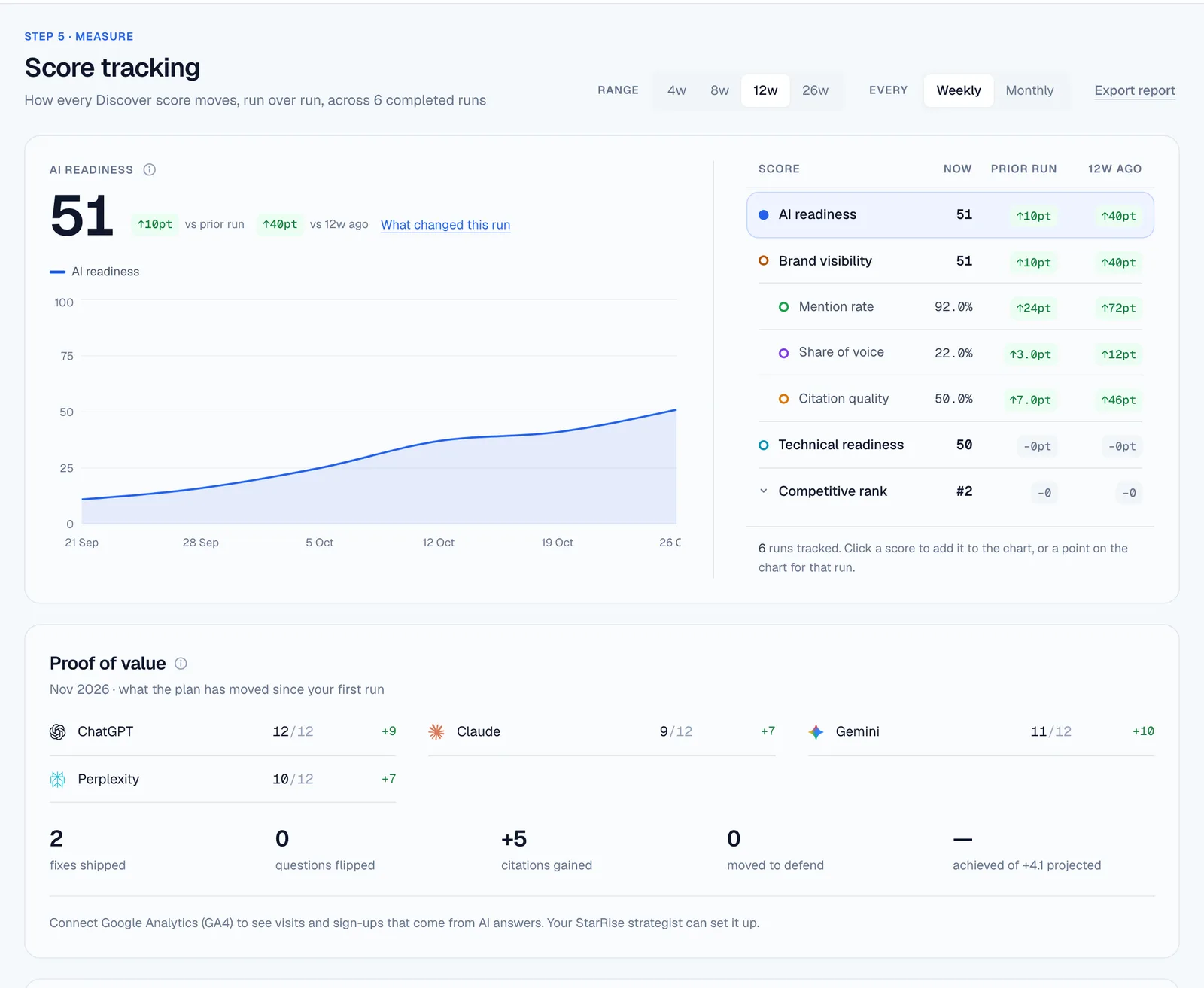
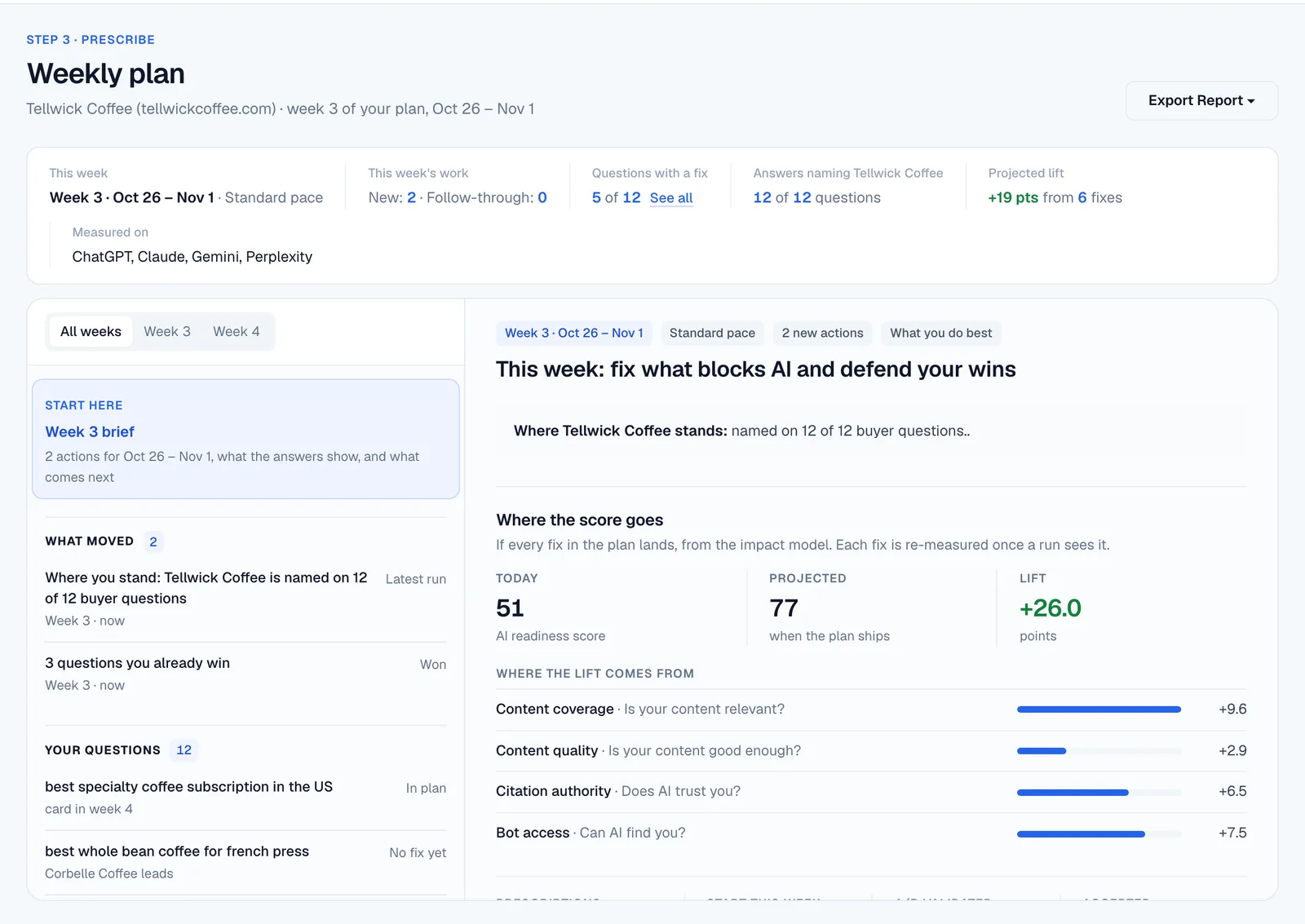
Every fix in your plan carries a projected lift: the score points we estimate it could add. Here is where that estimate comes from.
For content quality, the factors come from peer-reviewed research on generative engine optimization by Aggarwal et al., published at KDD 2024. It measured which content changes make a page more visible in AI answers. Statistics, quotations and cited sources were among the strongest.
Projected is the plan. Measured is the proof.
01
Compare with your strongest rival
We score your pages and your top competitor's on each factor the research shows engines reward.
02
Size the gap
The estimate grows with how far behind you are, how much that factor mattered in the research, and how many of your buyer questions it touches.
03
Stay conservative
Gaps the research doesn't cover, like missing pages or lost citations, use cautious estimates. The total never exceeds the room you have left to 100.
04
Show quick wins apart
Opening blocked crawlers is shown separately. It's often a five-minute fix.
05
Measure after the re-run
Once the changes are live and the engines have re-read your pages, we re-run and show the measured number next to the projection.
What we deliberately don't count
A score is only as honest as its exclusions. If we can't stand behind a number, we don't show it.
Unverified citations
Addresses the model types in prose and source lists it gives when asked afterwards are labelled and kept out of the score.
Questions that name you
Your brand name is never put in a tracked buyer question. Asking "is Brand X good?" would flatter anyone.
A single answer
One answer is never a result. On paid plans every rate comes from three samples per engine.
Failed calls and timeouts
If an engine fails or times out, that sample is left out, not scored against you.
Projected lift as a result
An estimate is never shown as an achievement. Only the measured number after a re-run counts.
Questions you add yourself are labelled, so you always know which results come from your own list. Every raw answer, for every question, engine and sample, is in Prompt Explorer.
Methodology questions
Three samples doesn't sound like much. Is it enough?
On paid plans each question goes to each engine three times (for ChatGPT, Gemini and Perplexity: twice through the official API and once in the consumer app), so one odd answer can't swing your score. The rate across your whole question list matters more than any single ask, and more samples cost more per run.
How do you choose the questions?
From your website and real search demand, rewritten into the questions buyers actually ask an assistant, across the buyer journey. Your brand name never appears in them. You can add your own, and those are labelled.
Do you measure what real users see?
Yes, on paid plans. Alongside the official APIs, we check the answers buyers see in the consumer ChatGPT, Gemini and Perplexity apps, and capture Google AI Overviews as they appear in search, because the apps don't always match the API.
Is projected lift a promise?
No. It's a conservative estimate grounded in published research. After you make the changes, we re-run and show the measured number next to the projection.
Can I see the answers behind my score?
Every one. Prompt Explorer shows the answer text for every question, engine and sample, run by run.